

My mother told me most of what I know about writing by the time I was about twelve years old. She was a writer, too—although her career was cut short by her early death, so early she was gone before her talent could fully flower and long before I even had the idea for my first novel. I can picture her quite clearly, reclined on a couch under a mohair blanket, dreaming up a story. Some writers have deep and powerful imaginations, more vivid than real life. That can’t be taught. As for what can be taught, I’ve summarized her thoughts in seven laws. Here they are, with commentary by me:
1. Organization is everything.
If the story isn’t organized, what have you got? A mess. To be organized, you must make some big decisions from the get-go, such as: What’s the POV? One character? Multi? Tell it in first person? Third? How about the tense? Tone? I’ve got a nice beginning but will it lead to an end? Getting stuck without an end is bad. Make sure an ending is possible, and “the world blows up” doesn’t count. There are maybe 10,000 decisions in writing a novel. Accept that.
2. Fiction is about reversals.
Just like high school or college wrestling (meaning real wrestling). It’s much more fun to watch a back-and-forth match than a blowout.
3. Torment your protagonist.
Or, flipping it the other way, don’t fall in love with your characters. And the main character—perhaps hero, perhaps not—needs to be tested.
4. Push everything as far as you can without contriving.
Get everything you can from your ideas—don’t leave the gold mine only partly dug. But stop before you do anything that makes the reader feel your behind-the-scenes presence and think that terrible thought: That couldn’t happen. Warning: pushing things as far as you can end up pushing you, the writer, out of your comfort zone and into new territory. Worth the risk? You be the judge. Alps and alps arise, as Pope wrote. And he would know.
5. Always advance the story.
Sometimes when you’re writing you’ll come up with a lovely little passage, a description of sagebrush at sunset, say, and a white dove gliding low. Does it move the story forward? No? Then out it goes. Shoot that dove! Is there one right word that will do the work of three? Banish that flabby trio. Sometimes you don’t need words at all!
6. Be original.
On every page! In every paragraph! No boilerplate! Ever! On the other hand, dropping in the very occasional cliché can be very powerful if the reader is accustomed to their rarity in your work.
7. Be playful.
You can be playful and dark in the same story. (Look around you.)
And here’s a writer’s block bonus for readers at Fresh Fiction: If you get stuck, take a step back and remember the engine that’s driving your story, its spirit, its heartbeat. Some narrative way forward will always suggest itself. (Please ignore this advice if your story is engineless.) In the case of the Chet and Bernie novels, the engine driving the story is the love between Chet and Bernie. Extra bonus: linger mindlessly in the shower. Thoughts will come.
CAT ON A HOT TIN WOOF by Spencer Quinn
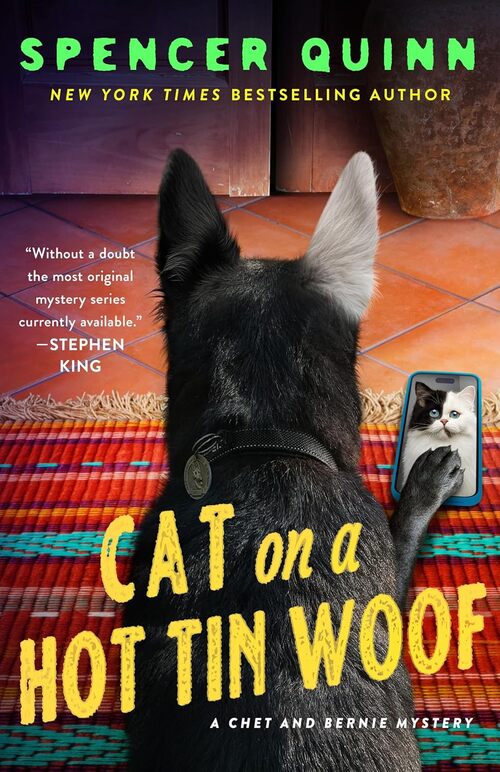
Join Chet the dog, “the most lovable narrator in all of fiction” (Boston Globe), and his human partner Bernie as they scramble to solve a case exposing the dark side of internet fame.
Chet the dog is less than enthusiastic about the Little Detective Agency’s next case. Chet and his human partner, PI Bernie Little, have been hired to find a missing person—only the missing person is a cat. Miss Kitty, an internet sensation, has disappeared, and Chet and Bernie have been hired to find her before her many followers realize something is wrong.
Miss Kitty belongs to Bitty, a sweet teenage girl who lives with her mom. Bitty and her mother are struggling financially, but the arrival of Miss Kitty and the chance discovery of her social media appeal has changed everything. Bitty now has sponsors, a high-powered agent, and all the tools needed to thrive online, and real money is flowing in. At least, it was. With Miss Kitty gone, the family’s income is on the line.
The case presents a slew of challenges for Chet and Bernie. For one thing, a potential witness is a pig named Senor Piggy who may be in possession of an important piece of evidence. For another, it seems like a possible perp has been killed twice—and there’s evidence implicating Bernie in the crime.
Humor [ Minotaur Books, On Sale: April 14, 2026, Hardcover / e-Book, ISBN: 9781250331779 / eISBN: 9781250331786 ]
Buy CAT ON A HOT TIN WOOF: Amazon.com | Kindle | BN.com | Apple Books | Kobo | Google Play | Books-A-Million | Indie BookShops | Ripped Bodice | Walmart.com | Amazon CA | Amazon UK | Amazon DE | Amazon FR
About Spencer Quinn

Spencer Quinn is the bestselling author of the Chet and Bernie mystery series, as well as the #1 New York Times bestselling Bowser and Birdie series for middle-grade readers. He lives on Cape Cod with his wife Diana—and dogs Audrey and Pearl.
No Comments
Comments are closed.