

Excerpt from THE MEANING OF MURDER. Text copyright © 2025 by Walter B. Levis. All Rights Reserved. Used with permission.
Not raindrops—blood. Blood falls from the black sky. Head back, neck craning, she strains to see, wincing as the drops hit her face. Thick red drops, pasty, mixed with white dust, the pulverized concrete of the fallen towers. This blood-and-dust mush—it swirls. Fat flakes swirling over the street, over the rubble, over the New York harbor, swirling like a shaken snow-globe model of lower Manhattan, sticking to the strange grotesque almost-unrecognizable human body parts that hang in the air: a blown-off hand, a stump of leg, a headless torso oozing a gelatinous trail of red-and-grey. Cheshire-style, the parts drift past, a floating parade.
She feels nauseous and her throat hurts and she wonders why she must watch this—why? Why her? The thick dust gleams red-and-white and the sheer size weight and volume of it—a crazy, blood-streaked fog, it so attenuates the sunlight that she stands in utter darkness. Like inside a movie theater before the show starts, but darker. No faint glow from the screen, no emergency lights from under the seats, nothing. Where are all the people? There should be throngs running and screaming, but she s alone. Until her father appears. He seems to hover a few inches off the ground. Then he takes her hand.
“Follow me,” he says, and leads her deeper into the darkness, inside a building, down an unlit hall, then outside again, onto a narrow street squeezed between cavernous buildings. They float together deeper and deeper into the darkness, into the oily, putrid odor of burnt plastic. And the sound—like the roar of a waterfall, she thinks. But strange—there’s no water. Her throat scratches and burns—aches for water—while her father, glowing, ghost-like, looks over his shoulder and smiles. Does he have water? He wears a clean suit and tie, well-fitted. His hair is combed. Dust-free, no blood on his clothes. “The hooker,” he whispers, then shrugs, squeezes her hand, looks away. Bashful, modest—a religious man. “Sex worker, I mean. If you knew what she knew…” She wants to ask: “What do you mean?” But fears if she opens her mouth, she’ll ingest the swirling white dust, swallow the big red drops of blood falling from the black sky. So she breathes through her nose, teeth clenched. Hard heavy breaths, straining for air.
When Eliana Golden woke, her jaw ached, a tightness deep in the joint. The dream—again. Same dream, third time. Or fourth? She pressed her thumb into the knotty muscle at her jaw, sending a bolt of pain into her ear, behind her eye, across her forehead. Migraine trigger. But no throbbing headache, not yet. Water. That’s what she needed. Her throat was parched. A cup of water by the side of the bed? No—another bit of therapeutic advice she failed to follow. Maybe she could fall back asleep. She reached for her watch. Brand new, a G-shock men’s digital, set for military time. She looked hard at the numbers, started to drop the big watch back on the night table, then put it on her wrist. Fuck it, she thought. Four hours of sleep—I’ll live.
She knew where Kitty strolled. And she’d find her—tonight, right now.
Eliana took a deep breath, then she threw her feet over the side of the bed and dropped straight into a close-grip push-up position on the floor in front of the nightstand. A quick set of ten, then a five-breath rest, and then another set, and another, until the muscles in her arms and shoulders burned. A good feeling—wide awake, ready for New York City at two in the morning.
The Queensborough Bridge cast a long shadow over 10th Street. A few sparse trees gasped for breath under the grey scaffolding at the corner. Further down the block, a temporary fence marked off a section for DOT parking, city officials only. Middle of the night, filled with cars—nobody bothered about the sign. Eliana sat in her beat-up Toyota waiting, watching. A cab stand at one end of the block, a parking lot for Silvercup Studios at the other—in between, girls of all sizes, ages, colors, and types. Teens with an easy sway in their young hips; middle aged vets fighting to keep some swagger in their wobbly knees.
#metoo.
The phrase popped into her head. Inappropriately, she thought, but, yeah, prostitutes still go to work. She thought of her sixteen-year-old
niece, who along with a bunch of her nice suburban girlfriends used magic markers to draw hashtags on the palms of their hands before they went off to parties. Will the whole fucked-up world of sexual harassment really be different for them? Eliana didn’t think so. Then thought: shit, I’m getting jaded. And that concerned her—exactly why her family thought becoming a cop was nuts. Why devote yourself to the ugliest parts of life? Her big sister Livi’s question.
She shook off the distracting thoughts. It was a warm June night. That explained the heavy traffic. She recognized some of these workers. A wide-hipped, big-breasted girl—sixteen, tops—hair dyed blue, her short-shorts halfway zipped, the top button open. She stood under the streetlamp with confidence, shoulders back, chest out, the glow of yellowish light giving her skin—regardless of its actual color—a gold tint. A few feet away, an older woman, a redhead, hung in the shadows until a shiny BMW pulled up, then she hobbled to the curb and waited for the window to roll down. No window, no business. And not worth the effort to try. But sure enough—the window opened, and out drifted the smell of money. They sometimes called it that. The old redhead took a chesty breath, a small step, and in a flash leaned over, pushing her sagging breasts through the open car window. Yes, indeed, Queens Plaza South, a new place to party.
Not tonight, maybe, but soon enough cops would crash this party— or, rather, move it. Pest control, the detectives called it. Spray regularly and you’ll keep the girls—and boys—out of your neighborhood, but they’ll always find another block. And street-workers—just a fraction of the industry. Online “escort services” thrive in a world of their own, protected by intricate licensing laws almost impossible for police to penetrate. Providing companionship, giving a massage—nothing illegal about this, as long as you’ve got the license, which means any law-abiding citizen with enough money to control an indoor space can buy and sell sex with impunity.
Early in her career, Eliana struggled to accept this. Why pick on the girls working the street? What about the 1,200 “rub-and-tug” parlors all over the city claiming to offer facials, reflexology, waxing, or, as one place on the Grand Concourse advertised: “The Work Day Whistle,” a special “happy ending” hundred-dollar massage, “hot stones included.” And don’t kid yourself: the New York State Division of Licensing Services required 500 hours of massage training. An army of regulators battle this paperwork, but meanwhile: a happy customer is a happy customer.
Eventually, she understood: cops keep their clothes on, which makes it tough to crack the criminal side of indoor sex. And prostitutes—well, not exactly criminals. Victims, mostly. And, if appreciated properly, these girls—and boys, and, of course, the transgender workers too—can be extremely helpful to police investigations. Hence, Eliana’s approach: the criminal world as ecosystem. It was a way of thinking that allowed her to feel OK about her work. And maybe that’s why she’d been so depressed lately: because she’d been forgetting the big theory, failing to trust the ideas behind it all. Not a pond or forest or grassland, but the criminal world is still an interactive set of processes that link the living to the non-living. And the system, like all systems, involves the transformation of energy into matter, and matter into energy. Bio-geochemical cycling. It can be mapped to show the importance of prostitutes.
She did this one night, laid poster board on the floor of her studio apartment and drew the “food web” of the “prostitution-system,” studying the linkages, tracking the cycling of elements. She placed a circle in the dead-center of the huge sheet of paper, and inside the circle, the word: SEX. Then she drew her lines and arrows, flowing from the ground up, expanding in all directions, the irrepressible force of sex like a fundamental nutrient supply to the higher trophic levels, where predators reign over grazers who lord over primary producers, a.k.a. street players. Sex, sex, and more sex. The precious resource. And bad guys do it differently, she knew. They don’t simply enjoy sex. They fight for it, kill for it, die for it. Which means, for a cop, if you want to find a perp— find the perp’s girlfriend. In fact, finding her might be even better, more helpful. And why do so many of these assholes have hooker girlfriends? Because in this ecosystem the capacity for genuine intimacy fails to be a dominant, adaptive process. Sexual energy finds release a simpler way: bucks for fucks. That’s a cop-phrase she hated, though it made an irrefutable point. Find a guy’s favorite hooker—find the guy.
What a theory. She told almost nobody, of course. Most cops don’t like this sort of thing, although Danny, her ex, put up with it, for a while. And—well, she admitted that her big ideas about prostitution were self-serving. Her career-bump—the gold shield—came from playing dress-up. Undercover work accelerated her career. But her fascination with prostitution went beyond that. It amazed her what a horrible, violent guy will say when he’s horny. The connection between sex and aggression. Love and war. A lot to learn here, especially for a nice Jewish Jersey girl.
There—getting out of a minivan, blowing her john a kiss, giggling, her small boney shoulders rising and falling in the dim light, Kitty, a Ukrainian-Russian caught in the traffic at sixteen. Now, all grown-up at nineteen: the sex worker from the dream? That’s what she hoped.
“You want to get me killed?” It sounded like keel-ed.
“I just want—
“Get away. I seen talking to cop—”
“What—I don’t—”
“Yessss—you fucking look like one—you—”
Kitty tugged on her stringy blonde hair, turned her head to look down the street. Then took a step away. Her purple halter-top minidress hung crookedly on slim hips, skinny legs, a paper-thin torso. A scarecrow with a painted face—purple eyeshadow, same shade as the dress, heavily rouged-up cheeks, thick dark lipstick and drawn-on eyebrows. All this failed to conceal a case of teenage acne.
“Bullshit, Kitty—I don’t—”
“Your fucking arms—too much muscle.”
In spite of herself, Eliana flinched, pulled at the bottom of her tight skirt, adjusted the scoop-neck see-through blouse. Kitty was right, of course. Too fit for the streets. That’s why she tended to work the high-end hotel sets.
“Look, we need to talk—”
“I answer you whole thing all in station. And you tell me—no more—and now—”
“Just a few quick questions—I promise.”
“Uchh,” Kitty turned her head, hard and fast, whipping her stringy hair across her face. “Fucking cop-promise.”
“What time do you eat? You gotta eat, right?”
“I no eat—no leaf—till six a.m.”
“Fine, 6:30. Court Square Diner, I’ll be there. And you be there, too.” She stepped closer, pushed two twenty-dollar bills into the palm of Kitty’s hand. “Just a few questions, and I’m buying breakfast. See you at 6:30.”
As Eliana turned away, she accidently caught a big whiff of Kitty’s lavender perfume. Absurdly strong, it almost made her sneeze.
A revolver’s cylinder spins with a soft metallic click. A soothing sound to Vachik Savoyian. His monthly ritual, the first Sunday: dawn, a single bullet, a single spin of the cylinder. Then the barrel goes into his mouth.
And he pulls the trigger.
Nobody knows. Not even his favorite girls, the ones who invite conversation. But every month for the past year—what are the odds? Same odds, of course, each month—one-in-six. The gun, though it had belonged to his father in the Iranian military, was an American-made Colt Single Action Army .45, 4.75” barrel, with an ivory grip. “Cowboy popper,” as collectors called it. This month, for some reason, the gun feels heavier than usual. Getting old, he thought, with a twinge of back pain as he lowered himself, fully clothed, into the bathtub. That’s where he always positioned himself. If the gun fired, his brains and fragments of skull would splatter across easy-to-wipe tile. Vachik Savoyian—always thinking of others.
He leaned back now, elbows on the side of the tub, then looked down into the gun’s long black barrel, its darkness like a tunnel with no end, the front sight at the tip, so integral. The Colt was a perfect gun, an archetypal gun, the weapon of the Wild West. And his father—a man he never knew—had used this exact gun, had left his sweat impregnated within this gorgeous hand-fitted mechanical sculpture created from forged steel. Yes, the fate of men shapes guns, and guns shape the fate of men.
But—silly feelings. It embarrassed Savoyian. Sentimentality. No wonder he’d told nobody about all this, not even that adorable Russian. A gun is a tool, like a screwdriver, a soulless instrument used to solve problems.
He thumbed the hammer, heard the unmistakable four clicks as it retracted, and quickly lifted his hand toward his mouth. The jerky move made his wrist ache—chronic tendonitis.
“Allahu Akbar” he whispered. And—although he’d told himself to bring the gun to his mouth, not his mouth to the gun—his head jutted forward, his lips wrapping tightly around the cool metal barrel. Then, a pause, a sniff—his nose felt stuffy, the smell of gun oil was faint. He swallowed hard, closed his eyes, and pulled the trigger.
Click.
Not a leaf falls, but He knows. Surah al-An am, 6:59
He pulled the gun from his mouth, wiped his lips, and got out of the bathtub. Then he dried the barrel, removed the bullet, and put the gun back in the same cloth bag his father had once used.
Now, part two: he lifted himself from the tub and sat down on the closed toilet seat, then lit a cigarette. He took a long hard drag. It helped him think. Helped him focus.
Unlike amphibians and reptiles, lizards and snakes, humans have neither a tough outer protection nor the ability to shed our integument en masse and replace it with a new coat. Savoyian had thought all this through, studied it. A voracious reader—autodidact, amateur philosopher. Minor sunburns, scratches, scrapes, and gouges create enough pain to remind us that we wear our feelings on the outside. A dangerous tendency. Either live or die, but don’t complain. Pain—like fear—is an essential aspect of the human condition. Some jobs—some lives—are harder than others, yes, but nobody—nobody—escapes pain and fear.
He rolled up one pant leg and brought the lit cigarette to his calf about four inches below his knee. Then he watched the burning tip heat the layers of his skin. First the ordinary cells—which are, technically, already dead. The burn formed a circle the size of a quarter, producing redness, swelling, and moderate pain; then the germinal layer—the red circle blistered, fluid bubbling, increased pain; and, finally, the support tissue under the germinal layer of skin turned white, then olive-colored, and then black, achieving the full-thickness damage of a third-degree burn. He wanted to scream in pain; but, of course, that was the training. He pulled the cigarette away from his leg and brought it back to his mouth and took another hard drag.
Before going out, he’d cover the wound with a small bandage and antibiotic ointment. Bacteria can find its way into sterile tissue beneath burned skin and establish major infections quite quickly. A nasty, pus-filled wound—that could be annoying. That could interfere with his work.
THE MEANING OF THE MURDER by Walter B. Levis
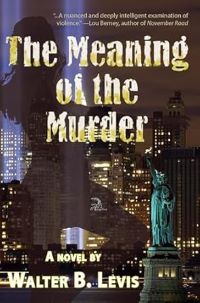
The father of a modern orthodox Jewish family works as a compliance officer at a bank in New York. When he discovers that his bank is violating OFAC laws and funding terrorists in the Middle East he alerts the bank’s top brass. They ignore him. After struggling with the conflict between his position as a fully assimilated member of his professional community and his moral obligations as a man and a Jew, he turns whistle-blower and goes to the DOJ. The night before his deposition he disappears.
Eliana Golden was thirteen when her father disappeared. Years later, after surprising her family by joining the NYPD, Eliana meets a mysterious and alluring soldier, a man who is far more dangerous than Eliana—and everyone except those at the highest and most secret levels of the U.S. government—understands. And he knows exactly what happened to her father.
What follows is a journey into the darkest depths of America’s covert war against terrorism and the horrific moral compromises it can entail.
The Meaning of the Murder is a psychological drama and a meditation on the moral ambiguity of violence, telling the multi-layered story of a family recovering from trauma, a detective determined to solve a crime, and the price we pay for safety in the war on terror.
Thriller Terrorism | Suspense Psychological [Anaphora Literary Press, On Sale: August 5, 2025, Paperback / e-Book , ISBN: 9781681146225 / ]
Buy THE MEANING OF THE MURDER: Amazon.com | Kindle | BN.com | Powell’s Books | Books-A-Million | Indie BookShops | Ripped Bodice | Walmart.com | Target.com | Amazon CA | Amazon UK | Amazon DE | Amazon FR
About Walter B. Levis

A former crime reporter, Walter B. Levis’ work has appeared in The NY Daily News, The National Law Journal, The Chicago Reporter, The Chicago Lawyer, The New Republic, Show Business Magazine, and The New Yorker, among other publications. He is author of the novel Moments of Doubt. His short stories have appeared widely, and have been chosen for a Henfield Prize and nominated for a Pushcart Prize. His new novel, The Meaning of the Murder, will be published in 2025 by Anaphora Literary Press. For 17 years he taught at the Ethical Culture Fieldston School in New York City. Previously, he served as a Dean at Columbia Grammar & Preparatory School.
No Comments
Comments are closed.