

Caye Caulker Island, Belize Tuesday, 10th January 2023
When I lied to him for the first time, it sparkled off my tongue as sweet as popping candy. He didn’t even know, he didn’t catch it, and I hadn’t planned to, not really. It just fell out of my mouth, and I wasn’t sure why.
Maybe it was shame. Was it shame, or something stronger? A defensive move I’d learned—or a preemptive one—because women have that kind of sixth sense, don’t they? Jacobson’s organ. I read about that once, in one of Dad’s New Scientist magazines, how females are predisposed to listen to their gut; how we can sense fear like we’re about to be fed it.
Through broken clouds, the sun warmed the sea. Turquoise medicine. I breathed it all in, deep into my bones. Jet Skis wasped in the distance, irritating the flat blues beyond.
Aid lay next to me, five thousand miles of relaxed. Tattoos wrapped around his chest, his neck, his arms, commemorating untold stories with blood and pain and ink. The newest—soft black and grey roses—graced his bicep afresh below the “L.F.” heart. He was resting on his elbows, his foot tapping a rhythm to the music in his ears I couldn’t hear.
He’d been distracted since we got to the island. When I’d asked over breakfast if he was nervous about meeting Dad, he insisted he wasn’t, got annoyed with me for asking. He barely ate any of his pancakes though, left most of his coffee. I’d wanted to tell him about the restaurant then but thought against it, deciding to wait until we were all a bit more relaxed.
Low, ebbing reggae from the beach bar drowned out my tinnitus, but on the offbeats I could still feel the buzzing electrics; they were never not there. The audiologist had told me to ignore them—the crazed sounds in my head—but it’s impossible to hear nothing when you’re listening for silence.
Running in and out of the waves, the kids were embroidering the sand near the jetty. The breeze kissed salty-sweet with their giggles; with my hearing aids, I could just make them out.
A soundless breeze teased the palm fronds above us, their shadows dancing grey upon the sand—grittier than I remembered it—narrower, too; the beach a gentle hem dotted with picnic benches, clam chairs, and slack hammocks. We just sat on towels.
Aid pulled the headphones from his ears. “How you feeling?” He started zincing his face. “Being back here, I mean?”
“It’s fine,” I said. “It’s good . . . I can’t wait to see the south.” A pelican squawked, eyeing up the fish below as it padded along the jetty.
“Ella seems relaxed.” The children seemed to simply slide into this place, leave the sludge of London behind.
“She needs a break.”
“We all do, but it is weird be again.” I lost some of his words to the crawk of the pelican, but his New England accent felt stronger than usual.
Dylan was rushing up the beach towards us, kicking up the sand. “Aid, will you come back in the ea with ?”
“Sure, little man,” Aid shouted. “Le m have a quick moke, then I’ll be in.” He turned to me. “When we mee ing your da ?”
I turned up my hearing aids. “I need to check with Chloe. She’s got it all figured out.”
“No shit.” Aid pulled his tobacco pouch out of my beach bag. “To be fair, she has organised the whole thing.”
“I thought he might want to meet me first, before everyone else.” “She wants to do it like that, thinks it will be more fun . . . You sure you’re not nervous?”
“Let’s not stay on too long. Once we’re done with the party, let’s hit Placencia, like we said. Beaches are better there anyway.” Aid hadn’t wanted to come to Caye Caulker again, asked why we couldn’t have visited Dad down in the jungle, which is what I’d wanted to do, too. But my sister had her plan, and I knew better than to mess with it. Besides, I liked the idea of being back here on the island; Aid just wasn’t nostalgic like that.
“Do you want a coffee?” I asked.
He was rubbing the last of the sunscreen into his tattooed arms. “Yeah. Thanks.”
I cast my eye towards the children. “Anything else?”
He grabbed me by the back of the neck, pulling me closer. “A kiss.” Under the shade of passing clouds, we breathed each other in. He smelt of coconut and wood, a moreish musk I had to prise myself away from.
“I love you, Wylde,” he called after me as I made my way across the sand. “Wildly.” I turned to smile at him, his blue eyes tracking mine.
A young couple and their toddler beat me to the kiosk. She was beautiful, the woman. She looked Scandinavian, but they started speaking to each other in something else—German, maybe, or Dutch. Arguing with the girl about what she wanted to order, they were gesticulating back and forth between her and the faded ice-cream board. The sun so bright through the clouds, I had to squint to make out the scrawled chalk on the side of the hut: iced coffee, belikin, smoothies.
The girl started to whine, stomping her flip-flopped little foot. “Room- ijs, roomijs,” she singsonged.
I could feel my body acclimatising—sinking into the fortnight. It felt so good to be in a bikini, to finally be away. We hadn’t had the money to go abroad for so long, and now it felt even more precious. I tried not to think about what happened with Aktar and the restaurant, how we’d left things. This was pretty much paid for, so I’d enjoy it, worry about worrying when I was back home, but then, of course, I thought about Aktar, and the restaurant, and how we’d left things. Fuck. I needed to call him, needed to apologise again. And I needed to tell Aid.
He was lying flat then, deadening his cigarette butt into the sand. His body bragged incredible, even from this distance. I lost sight of it some- times, but there was no doubt about it—people noticed him; and he liked to be noticed. Three years in, all I had to do was look at him and my head still dissolved.
A heavy grit-grey had appeared as if from nowhere on the horizon. The kids were splashing each other now, kicking the water, not too deep. Ella, even at fourteen, still enjoyed playing with Dylan. I flashed in my mind to a day when I might no longer be able to hear them, my own children—the cruellest void imaginable. I had to remember this all.
“Nee!” The blond woman shouted in front of me, side-eyeing her husband, bending towards the girl who was stamping her other foot.
Ella was in deeper now, swimming closer to the jetty, where a speed- boat was coming in from the distance. She looked so much taller than last time I’d seen her in a swimsuit, her limbs impossibly long. Only a few years ago, she’d been so clingy, so wholly dependent on me; now though, she was blooming wildly—so enigmatic and ripe with possibilities.
The boat whipped close by the tip of the dock, an aftermath of waves gathering and spilling.
A woman in a red bikini got up from a nearby table, her chair pushed back. She took a final draining sup of coffee and tossed down her newspaper, the pages rustling in the gathering breeze. The title caught my eye, Amandala, and then the headline:
Shooting on Logwood Street. Man Dead. Police Hunt for Zabaneh.
“Roooooooom-ijs,” the toddler screamed in front of me until it pierced into my ears. The water was picking up now, cascading over the sand. Ella was up to her chest, rising and falling, defensive against the newly violent sea. I scoured the shoreline, thick grey clouds bruising the sky behind. Where’s Dylan?
A chill riptided through me. I swept my eyes back and forth, colours blurring. I could still make out Ella, disappearing up and down in the waves. But no Dylan.
LIME JUICE MONEY. Copyright © 2025 JuiceMoneyLtd by Jo Morey. Reprinted here with permission from Harper, an imprint of HarperCollins Publishers
LIME JUICE MONEY by Jo Morey
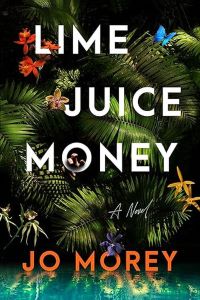
With the sultry atmosphere and ratcheting tension of The White Lotus, The Mosquito Coast, and Nine Perfect Strangers, Lime Juice Money is an intoxicating, sensuous debut that follows a woman trapped in an increasingly volatile relationship 5,000 miles from home in a Central American jungle.
A woman losing herself. A brutal relationship. And a jungle full of secrets.
When disaster strikes, hearing-impaired Laelia Wylde leaves London with her new partner, Aidrian, and her young children, hoping for a fresh start in the verdant jungle of Belize. There, she can be closer to her botanist father, get away from her sister, and maybe find a way to open the restaurant she’s always dreamed of.
While the jungle is mesmerizingly beautiful, it is also unforgiving and brutally hot, filled with deadly creatures and sinister magic. Laelia’s fragmented recollections of the past are increasingly bewildering, the gunshots she hears at night through her worsening tinnitus seem to be getting closer, and she still doesn’t understand why her father tried to turn her against Aid when they first met—though maybe she just misheard.
Uncovering long-buried secrets that threaten to derail everything, Laelia must somehow find the courage and resilience she needs to survive. Or is she destined to disappear into the shadows, like the orchid her father named her after?
Lime Juice Money is a twisty, searing journey of raw love, betrayal, corruption, and greed in a shaken paradise, pulsating with danger both inside and outside the door.
Thriller Domestic | Women’s Fiction Psychological [HarperCollins, On Sale: August 12, 2025, Hardcover / e-Book , ISBN: 9780063399266 / eISBN: 9780063399273]
Buy LIME JUICE MONEY: Amazon.com | Kindle | BN.com | Apple Books | Kobo | Google Play | Powell’s Books | Books-A-Million | Indie BookShops | Ripped Bodice | Walmart.com | Target.com | Amazon CA | Amazon UK | Amazon DE | Amazon FR
About Jo Morey

Jo Morey has a BA in English Literature and French. She has lived and worked in Paris and New Zealand, and now lives at the foot of the South Downs in the UK. Like her protagonist, Jo also suffers from a hearing impairment and constant tinnitus. Lime Juice Money is her first novel.
No Comments
Comments are closed.