

Excerpt from OFF THE RECORD by Sara Goodman Confino:
“The nerve of that man!” I exclaimed for about the third time.
In the end, we formed a group of twelve girls for lunch, and we grabbed sandwiches from a deli to eat outside in Farragut Park. We lacked a picnic blanket, so we crowded onto the low wall surrounding the statue of the Civil War admiral, who, the plaque told us, coined the phrase “Damn the torpedoes—full speed ahead.”
I looked up at the statue’s face, thinking I detected a hint of a grin. As annoyed as I was at Fields, the camaraderie of the typing pool ladies made the sun seem to shine brighter.
“I told you I didn’t like him,” Patricia reminded me.
“Yeah, but you thought he knocked Louise up.”
Most of the girls laughed. “He isn’t Louise’s type at all,” Connie said. “She liked them older and married.” My mouth dropped open.
“Oh, honey,” Gladys said. “Don’t look so shocked.”
“Be nice,” Patricia said, elbowing Gladys. “It’s her first week. The old men upstairs don’t even know she exists yet.”
“Are you serious that Louise got pregnant by a married man?” I asked. “What’s she going to do?”
Carol shrugged. “Take care of it or hope he takes care of her.”
Of all the girls I knew who had found themselves in trouble, only one didn’t get married. Granted, a girl who lived on my floor in college got married quickly after and it was not to the boy whom she had been seeing prior to missing her cycle. Betty once whispered to me that that was why religion came down from the mother’s side. A father wasn’t a guarantee.
And the one who hadn’t gotten married, well, her mother had taken her to a special doctor, and suddenly there wasn’t a problem anymore. So I knew these things happened. But the blasé nature with which they were being discussed by women in the working world was a bit jarring.
Still, I felt for Louise, despite not knowing her. She had made a mistake, but the options left for her future were dismal at best, with zero consequences for the man who was just as much, if not more, at fault. He was the one who had taken—and broken—vows after all.
Not that I would be taking Patricia up on her diaphragm advice.
Keeping my legs closed was enough, thank you very much.
“So if we’re not allowed to fraternize, and the editors are married—”
“Most of the reporters are too,” Deborah chimed in.
I involuntarily pictured Fields’s ink-stained hands. I didn’t remember seeing a ring. But then again, if he wasn’t Louise’s type because he was young and unmarried, there wouldn’t be one, would there?
I grinned devilishly. “Then who, exactly, are you using that diaphragm with, Patricia?”
Everyone burst into whoops of laughter. I looked over to make sure I hadn’t offended her, but she was laughing hardest of all.
“This month? Or last?”
Gladys elbowed her. “You’re terrible.”
“And what are you?” Patricia asked.
“Terrible,” Gladys said, laughing merrily.
“It’s not like the old days,” Connie said. “We might as well have a little fun before we settle down and get married and start popping out babies.”
I thought of Betty, pregnant with her third and just a couple years older than me, and agreed.
Though my idea of fun was different from theirs.
I looked up at the statue behind me again as we stood to leave. I had no idea what he had done besides say that line. But I doubted he would let another man take credit for his work.
Then again, who knew if he had actually said, “Damn the torpedoes”? Maybe he just took the credit himself and now had a statue while the poor slob who had actually said one of the most famous military quotes in history rotted, forgotten, in a rural cemetery.
I may not have had much power in this field or this world overall, but as I looked at my coworkers, all in bright, colorful dresses, most arm in arm walking back to the office, I realized we had more sway than any man in there gave us credit for. And maybe more than we ourselves thought too. If we walked out, the newspaper would shudder to a halt until they could replace and train an entirely new typing pool.
Not that any of us would do that. We all worked here because we needed the money, myself included, even if my main motivation was to move up the ladder to reporter.
And realistically, I wanted Fields’s job. Well—okay, not junior White House correspondent. I wanted to be the real deal. I didn’t want to be reporting solely on women’s issues, which most of the few female reporters out there did. My mother may have devoured the For and About Women section of The Washington Post, but my father, Uncle Gil, and Betty’s husband wouldn’t touch that section with a ten-foot pole. I wanted to write stories that everyone read.
With my name on the byline. Front page. Above the fold.
“Judy!” Patricia said, and I realized from her urgency that it wasn’t the first time she had called my name.
“Sorry,” I said. “Head in the clouds.”
She nodded toward the front door of The Digest, where Fields stood, a bouquet of wildflowers in hand.
“Think you have an admirer.” The girls tittered.
I rolled my eyes. “An apology so he can keep taking credit for my work isn’t the same as an admirer. Besides, imagine me bringing home someone with the last name Fields. My mother would lock me in the house and never let me out again.”
Real laughs this time. Their mothers would be equally horrified if any of them brought home a Jewish man, as Gladys had pointed out on my first day—was that really only two days ago? So much had happened since then. I felt worldly and wise compared to that naive girl.
“You’ll need a better bouquet than that, Fields,” Patricia said as she passed him.
“Aw, lay off me, Patti,” Fields said.
Patricia laughed and pinched his cheek. The two of them stood about eye to eye with Patricia in heels. I would have had to stand on an apple box to do the same.
I tried to walk past him, but Fields grabbed my arm. “Listen, Judy, I—”
“Miss Greenberg,” I reminded him. “I’m not on a first-name basis with thieves. Now if you’ll excuse me.”
“I’m not a thief,” he said, wounded. But he hadn’t dropped my arm.
“Are you okay?” Carol asked me.
I debated saying no and letting the typing pool overpower Fields. But even with Miss Kelly’s promised backing, making a full enemy in the newsroom didn’t seem smart. So I nodded and told her I would see her inside in a minute.
“Give him the old right hook if he gets handsy,” Gladys said to riotous laughter.
I shook my head and shooed them with my free hand. Then I turned back to Fields. “What do you want, Fields?”
“To apologize,” he said. “I didn’t mean any harm. You did really great work, and I was impressed. If you think about it, it was actually kind of a compliment.”
“A compliment,” I repeated. “To make everyone think you did such great work on your own?”
He smiled painfully. “Okay, well, when you put it that way . . .”
He sounded sincere. But I was so tired of having to fight for everything that he was handed just because I was a woman. “Good day, Mr. Fields.” I wrenched my arm free and started toward the door.
“Judy—I mean Miss Greenberg, wait.” I stopped but didn’t turn around. “You’re—you’re good. You’ve got a really good eye.” I turned halfway, which encouraged him to continue. “Why don’t you go get a job at one of the papers with a women’s section? I’m sure someone would hire you in a second.”
In a flash, I was in front of him.
“So I can write about fashion and hairstyles and how to get a stain out of a pair of your husband’s trousers?”
“Well, I don’t have a husband, but—”
“Because I don’t want to do that. I want to cover the news. The real news that everyone reads. Not just my mother and her friends. How many women are there in the White House Press Corps?”
“One,” he admitted.
“Helen Thomas,” I said. “That’s it. And she got hired as a reporter during the war because so many male correspondents were overseas. Now everyone is home, and we’re just expected to stay in our kitchens or write about what to do in one.”
“There are plenty of women who have done important work in journalism though. What about—”
“I swear to God, if you say Nellie Bly right now . . .” He shut his mouth. “Exactly,” I said. “You can name two.”
“Anna Wainwright worked at The Post before—”
“Before she got married,” I finished for him. “And her father owned the newspaper. Why isn’t she running it now?” He closed his mouth again.
“I wasn’t born an heiress. I live with my parents in Silver Spring. There isn’t a war going on to clear the newsrooms. And I don’t have Joseph Pulitzer funding my crazy adventures. What I have is a good work ethic, strong writing abilities, great typing skills, drive, and grit. And when a man like you tells everyone that you’re the one doing what I can do, it makes it harder for me to get ahead. Do you understand yet?”
For a long moment, he said nothing. Then, very quietly: “I do. And I’m sorry.”
“Yeah, well that and thirty-five cents will buy you a cup of coffee.” I looked down at the flowers, still in his hand. “Did you pick those yourself?”
He nodded. “From Franklin Park.”
“Which is federally maintained. So that was illegal.” He blanched, and I felt a little sorry for him. But a quick glance up showed me that the typing pool was watching us through the lobby windows, and I didn’t want to show weakness in front of them. “Have a nice afternoon,
Mr. Fields. I have work to do.”
And with that, I swept into the building, leaving him gawking after me.
“Lovers’ spat?” Frank asked at the door. I scowled.
“Absolutely not.” Frank chuckled.
Later, at my desk, I found my mind wandering to his apology. It had felt genuine. And it wasn’t like anyone upstairs—except Fields—was going to believe the work was mine anyway. But I shrugged. I had slammed that door closed, and I doubted he’d be back with an article for me anytime soon. I might as well focus on what was in front of me.
An excerpt from OFF THE RECORD by Sara Goodman Confino
Text copyright © 2026 by Sara Goodman Confino
All rights reserved
OFF THE RECORD by Sara Goodman Confino
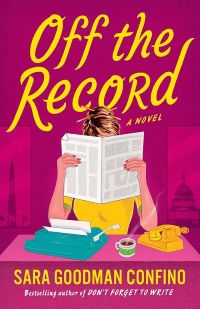
An aspiring newspaper reporter comes across a mystery that threatens to turn the Cold War hot in a funny, thrilling, and strictly undercover romantic comedy by the bestselling author of Don’t Forget to Write.
In 1962, opportunities are typically few for nice Jewish girls clacking away at ninety words per minute in a newspaper typing pool. Except Judy Greenberg isn’t typical. An aspiring reporter in DC, she’s aiming for journalistic greatness—not finding a husband. Just don’t tell her mother.
Then one day she answers her boss’s private line. The message is curiously cryptic. It’s also delivered in a Russian accent. Judy is certain she has stumbled upon a scoop. Charming reporter Jack Fields isn’t one to dismiss Judy’s instincts. Perfect. A seasoned ally she can trust, not to mention pass off as a pretend boyfriend around her relieved parents. Together, they’re following the leads—from a clandestine hotel bar to the dressing room of a slinky Cuban nightclub singer to an exhilarating underground of secrets and spies stretching from Moscow to Havana to Texas.
Now Judy must choose between the safe life expected of her or one hell of a dangerous story that could make her career. She might even fall in love for real. If her ambitions don’t get her killed.
Mystery Woman Sleuth | Women’s Fiction Historical [ Lake Union Publishing, On Sale: June 9, 2026, Trade Paperback / e-Book, ISBN: 9781662537554 / eISBN: 9781662537561 ]
Buy OFF THE RECORD: Amazon.com | Kindle | BN.com | Apple Books | Kobo | Google Play | Books-A-Million | Indie BookShops | Ripped Bodice | Walmart.com | Amazon CA | Amazon UK | Amazon DE | Amazon FR
About Sara Goodman Confino

Sara Goodman Confino teaches high school English and journalism in Montgomery County, Maryland, where she lives with her husband, two sons, and two miniature schnauzers, Rosie and Sandy. When she’s not writing or working out, she can be found on the beach or at a Springsteen show, sometimes even dancing on stage.
No Comments
Comments are closed.