

What is the title of your latest release?
A THOUSAND CUTS
What’s the “elevator pitch” for your new book?
It is the story of a former CIA officer, Max Starkey, who is down on his luck and working for the mob recovering stolen money. He is pulled into a heist by the woman who broke his heart and his old rival in the agency, who are married to each other now. They are attempting to move four thousand pounds of gold bars out of a Southeast Asian country on behalf of a dictator who is about to be toppled in a coup, but they intend to steal them. Of course everyone has their own agenda and is planning to betray everyone else.
How did you decide where your book was going to take place?
I decided to set the novel in Southeast Asia mainly because I have traveled extensively there and know the region well. Also, it lends itself readily to description, and I believed I could use my words to evoke the feeling of actually being there. I also wanted that cloying feeling of everything closing in on Max, and that’s the jungle. However, I decided to set it in a fictional country and created a small nation called Suryaka, which is nestled between Thailand, Laos and Myanmar. There were a couple of reasons for this. First, I knew there would be historical storylines that wouldn’t match any existing country’s past. Conversely, I also felt obligated to reality. Thailand has a monarchy that they respect and revere, and to pretend that it never existed would be an insult to them. At the time that I started writing, the humanitarian crisis in Myanmar was ongoing, refugees were fleeing and Rohingyas were being massacred; setting it there felt like I would be trivializing their plight. And Laos has a firmly entrenched Marxist government that rules with an iron fist, and unraveling that would mean rewriting their entire modern history. The argument could be made that in a work of fiction these considerations don’t matter, but they did to me and so Suryaka was born.
Would you hang out with your heroine in real life?
I would absolutely hang out with any of the leads in the book, except maybe Derek, who is kind of an arrogant a-hole. At least long enough to hear some of their stories. I wouldn’t want to hang around too long though, because these characters live on the edge and I’d be afraid that I’d wind up in jail or dead. Plus, I could never keep up with them, they don’t slow down much. So I guess the bottom-line answer is, I’d hang around with them but I’m not too sure they’d want to hang out with me.
What are three words that describe your hero?
Broken. Adventurous. Romantic.
What’s something you learned while writing this book?
How to write a book! That’s a joke, obviously, but it’s also true. I’ve been earning my living as a writer for 35 years, and this is the first thing that I’ve ever written that didn’t start with the same two words: Fade In. After years of only being able to write two things, what the audience hears and what they see, I found it liberating to be able to use more description and particularly the inner monologue. I was able to really delve into the background and psychology of my characters as opposed to only being able to hint at it like you do in a screenplay, and I found that truly joyful. I also really enjoyed being able to write more spontaneously. Screenplays are very structured and there is a rigid page count, and you can’t really go off on too many tangents. Many times, when writing a screenplay, you’ll think of a subplot or a character you’d like to explore, but there just isn’t enough real estate so you have to let it go. One of my favorite parts of A THOUSAND CUTS is a subplot about a young woman being stalked in the jungle by a tiger, and the battle of wits she engages in with this apex predator in order to survive. It wasn’t planned, it just came up spontaneously while I was writing, and it became integral to the book. It is the perfect example of the kind of thing that would never happen in a screenplay. Maybe you would set it aside and try to use it somewhere else, or in a movie of its own, but it would not make it into a script as a subplot. So the amount of artistic freedom that comes with writing a book as opposed to a screenplay is the main thing I learned.
Do you edit as you draft or wait until you are totally done?
I have a habit I developed years ago that I employed, which is that I start writing each day by rewriting the previous day’s pages. It serves as kind of an onramp and gets my creative motor running for the day’s work. Other than that, I really only go back if I think of something new that I want to add or change before I forget, or if something I write now necessitates a change earlier on. In general, I try to get the first draft out before I do any real rewriting. I believe the first draft is its own reward. I think a lot of writers get bogged down in thinking the first draft has to be perfect, but it doesn’t. Let your characters say exactly what they mean; you can go back and add subtext later. In my mind, the first draft is the hard part, and the rewriting is the fun part, so I try to get the hard part done as quickly as possible.
What’s your favorite foodie indulgence?
Ice cream. No hesitation. The first thing I do when I visit a new place is find out about the ice cream. Where are the good places? Which shops make their own? What’s their signature flavor? When my kids were little I once took them on a three-week driving tour of all the best and/or interesting ice cream spots on the eastern seaboard. We visited seven states. You know how in Leaving Las Vegas Nicolas Cage stops eating and does nothing but drink alcohol until he dies? I always joke that when it’s my time to go I will do the same thing, but with ice cream.
Describe your writing space/office!
I have converted the front bedroom of the house into an office where I am surrounded by books, and memorabilia from all my movies. But the truth is, a lot of the time I go out and work somewhere else. I work really well in public places; hotel lobbies, airplanes, restaurants. Sometimes I go to our local library branch and write there, and I’m that pretentious guy you see working on his screenplay at Starbucks. I wrote the season finale of a television show in video village, with all the craziness of production around me. My wife and I raised four humans, so I have always had to write in relative chaos, and I suppose it’s part of the process now.
Who is an author you admire?
Oh my. There are too many to list. I really admire the prolific, Steven King, Karin Slaughter, Michael Connelly. I think it’s harder to write two dozen really tight, entertaining thrillers than it is to write one “great novel”. I admire J.D. Salinger, but I’d rather be James Patterson. I love reading Don Winslow, Raymond Chandler, Mickey Spillane. The hard-core guys like that.
Is there a book that changed your life?
The Chronicles of Narnia series. I first encountered them when I was 10 or 11, and I read them over and over again. They just blew my mind and opened my imagination up to the possibilities of storytelling. I was too young to get the religious undertones, but they were the greatest thing I had ever encountered at that age. Also, in a weird way, PLANET OF THE APES by Pierre Boulle. I read that as a kid and I remember having this experience where I thought I could see how he wrote it, like the words were being put down on the page as I was reading them. I could see the process, and it seemed like something I could do. Of course I learned later that it was a translation from the original French, but at the time I didn’t know that. I just had this bizarre sense that I was sitting at the typewriter watching him go. I’ll never forget it.
Tell us about when you got “the call.” (when you found out your book was going to be published). Or, for indie authors, when you decided to self-publish.
It was an amazing moment. I am not a first-time writer, obviously, but this represents a major career change for me, going from the film business where I am a known commodity to the publishing world where I am a complete nobody, so it represents a pretty big risk. When I got the call, I was writing at my desk working on a script. I’m pretty sure I whooped, then I found my wife and kissed her, then I texted everyone I had ever met. Then my wife reminded me that I was on a pretty tight deadline and I went back to work.
What’s your favorite genre to read?
Again, this is hard to answer. I probably read the most crime thrillers, Reacher, Bosch, Lincoln Lawyer, Elvis Cole, anything by Karin Slaughter. But I really love reading all different kinds of things. This past month I read Homegoing by YaYa Gyasi, the Rome trilogy by Elodie Harper, and Age of Vice by Deepti Kapoor. I once read that Stephen King said a writer should write four hours a day and read four hours a day. I don’t quite meet that, but I am a voracious reader and I’ll read any book that I hear is good. The only caveat is that I read much less nonfiction than I did when I was younger. I prefer fiction now, the real world is too unbelievable.
What’s your favorite movie?
I am powerless to answer this question. Movies are my passion, and I love so many of them. I watch Turner Classic Movies every night. I can tell you that my favorite movie that I’ve written is Knox Goes Away. But as for all movies, there are hundreds, maybe thousands, that could be my favorite. Here are a few that pop to mind: The Godfather, The Man Who Shot Liberty Valance, Sullivan’s Travels, Bringing Up Baby. And on and on and on.
What is your favorite season?
I grew up in Hawaii, where there are no seasons, and now I live in Los Angeles, where the four seasons are Fire, Earthquake, Mudslide and Oscars. Next question.
How do you like to celebrate your birthday?
I don’t particularly. I’ve had a lot of them at this point, and I tend to let them slip by quietly. One of my sons was born two days before my birthday, so I have been able to hide mine behind his which is very convenient.
What’s a recent tv show/movie/book/podcast you highly recommend?
I enjoyed A Knight of the Seven Kingdoms, and I love the TV version of Will Trent. My wife and I are watching Tehran and the new Steve Carell show, Rooster. I missed a lot of stuff when my kids were younger, so I am just now watching Warehouse 13 and Eureka, two sci fi shows I really like. And any British mystery, the cozier the murder the better. My wife got me a t-shirt that says:

What’s your favorite type of cuisine?
My wife Anya is Russian so I eat a lot of cool stuff I never would have been exposed to otherwise. She makes amazing borscht. People who don’t like borscht like her borscht.
What do you do when you have free time?
Have what now? Kidding. I read, work out, go to movies, and do some hiking. I am a passionate Lakers fan and have had season tickets for over 30 years. We also enjoy live theater and the occasional concert.
What can readers expect from you next?
The sequel to A THOUSAND CUTS, also featuring Max Starkey and titled THE THIRSTY SAND, is with my publishers now. I have three or four movies in various stages of prep, but I want to focus on the novels as much as possible. So if you see a pretentious guy writing in Starbucks, say hi.
A THOUSAND CUTS by Gregory Poirier
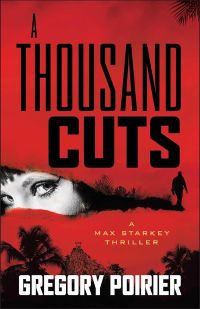
From Hollywood screenwriter Gregory Poirier (National Treasure: Book of Secrets, Rosewood, Knox Goes Away) comes an espionage thriller with the grit of Lee Child, the emotional punch of S.A. Cosby, and the atmospheric intrigue of John le Carré. A Thousand Cuts introduces Max Starkey—disgraced CIA operative turned underworld fixer—whose past loves, rivals, and indiscretions are coming for him in the jungles of Southeast Asia.
From the steamy streets of Bangkok to the suffocating depths of the Laotian rainforest, A Thousand Cuts is a high-octane thriller about loyalty, betrayal, and redemption. Blending emotional depth with explosive action, Gregory Poirier’s debut novel introduces a new hero who bleeds, breaks, and doesn’t back down.
Max Starkey walked away from the CIA after a mission in Laos went wrong—horribly wrong. Seven years later, he’s living in the gray spaces between criminals and justice, earning a living recovering stolen goods for villains who know better than to ask questions. But when he’s lured to Bangkok under false pretenses, Max realizes his past isn’t done with him.
The setup: an old flame, Kelly Riggs, now married to his rival, Derek Moss. The job: steal $130 million in dictator-owned gold before a coup kicks off. The problem: everyone’s planning a double-cross—and Max is the mark.
But things get even more complicated when Max’s “companion,” Giuliana Abara, turns out to be an undercover FBI agent with secrets of her own. Caught in a deadly web of betrayal and political violence, Max must choose between old loyalties and new truths.
A Thousand Cuts is a gripping tale of espionage, survival, and love in a world where trust is a liability and redemption comes at a steep price.
Fiction Adventure | Action | Thriller Political [ Diversion Books, On Sale: April 28, 2026, Paperback / e-Book, ISBN: 9798895150900 / eISBN: 9798895150917 ]
Buy A THOUSAND CUTS: Amazon.com | Kindle | BN.com | Apple Books | Kobo | Google Play | Books-A-Million | Indie BookShops | Ripped Bodice | Walmart.com | Amazon CA | Amazon UK | Amazon DE | Amazon FR
About Gregory Poirier

Gregory Poirier is an acclaimed screenwriter, director, and producer whose work spans film and television. His credits include National Treasure: Book of Secrets, Knox Goes Away, and Rosewood. A graduate of the USC School of Theater and the UCLA Masters program in screenwriting, he brings a sharp, cinematic eye to fiction. A THOUSAND CUTS is his debut novel. He lives in Moorpark California with his wife Anya. They have four adult children.
No Comments
Comments are closed.