

What is the title of your latest release?
HEMLOCK LANE
What’s the “elevator pitch” for your new book?
In 1967, a budding feminist must find a way to break away from her high-strung, domineering mother, without threatening the tranquility of the entire family.
How did you decide where your book was going to take place?
As I settled on a time period (1967) for the novel’s “present,” I realized that a generational story including upward mobility that began in the Bronx would probably lead to a life in the suburbs. Having lived in suburban Westchester County for going on forty years, I knew many people whose families had made that same trek, whether to Westchester, Long Island or New Jersey. I chose a neighborhood in Sleepy Hollow, NY, where friends live. A little research proved that my timeframe worked, in terms of the subdivision’s history—and I could drive through the Levitsky family’s “neighborhood” for visual research any time I wanted.
Would you hang out with your heroine in real life?
I see the heroine as someone different from the protagonist in the book, though the answer is yes in both cases. The protagonist in the book is Nora, the daughter who comes home for a weekend and a confrontation with her mother. A male friend who read an early draft said, “I wanted to date Nora.” I felt much the same way. But I also would want to hang out with Clara, the family housekeeper who, in my mind, is the heroine of the book. She could probably teach me a lot about being a better cook and baker.
What are three words that describe your hero?
Loving, loyal, resilient
What’s something you learned while writing this book?
It was more like re-learning something, or maybe two things: No one thinks they’re a villain in their own life; and, You never know what burden someone else secretly carries. Which, of course, is the starting point for empathy.
Do you edit as you draft or wait until you are totally done?
I live and die by this idea: All writing is rewriting. When someone asks how you write a novel, I tell them to just spill that whole first draft on to paper before you go back and start evaluating anything you’ve done. It’s OK to reread what you wrote the day before to remember where you are—but then keep going. Write everything you’re thinking before you stop to figure out what you’ve got.
What’s your favorite foodie indulgence?
Sushi. My wife doesn’t like it, so it’s reserved for that one night a month she’s gone to her book club.
Describe your writing space/office!
I have a home office on the second floor of our house that used to be my younger son’s bedroom. There are a couple of large filing cabinets full of receipts, bills and other papers (all of which advertise just how analog I am), along with a closet containing a set of bookshelves holding copies of my books and office supplies.
There is a bulletin board hanging above my desktop Mac that is, in essence, an ever-changing collage of snapshots, postcards, movie memorabilia, and other visual souvenirs from my time working in this room. There’s also a large collection of credentials from various film festivals and other events, hanging from lanyards on a hook. There are a recliner and ottoman for naps, and a fainting couch (like in a psychiatrist’s office) on which I throw workout clothes and also occasionally nap (when I can clear space among the workout clothes). The walls are covered with photographs from my journalism and writing career, along with blow-ups of covers of my books and movie posters that include a quote from my review of that movie.
Who is an author you admire?
Too many to limit it to one: from Jane Austen and Charles Dickens through Wharton, Fitzgerald and Hemingway to Vonnegut and Elmore Leonard.
Is there a book that changed your life?
As with many people my age, I could point to The Catcher in the Rye, which was given to me by my ninth-grade English teacher. She saw that I was reading James Bond novels (which, I maintain, taught me the rudimentaries of sex) and handed me Salinger’s earth-shattering novel, which radically changed my 14-year-old ideas about literature.
Instead, let me name The Electric Kool-Aid Acid Test, by Tom Wolfe, which super-charged my ideas about being a reporter, with its blast of new-journalism juice. (Followed closely by Hunter S. Thompson’s Fear and Loathing in Las Vegas, which was all that plus hilarious.)
Tell us about when you got “the call.” (when you found out your book was going to be published). Or, for indie authors, when you decided to self-publish.
It was my second book with the same editor/publisher, so it was a very friendly conversation, and a satisfying one, about continuing an artistic collaboration. That was extremely gratifying.
What’s your favorite genre to read?
Detective fiction/crime fiction/thrillers, because I could never write one. I believe you need to be someone who gravitates toward puzzles—crossword, jigsaw, Wordle, etc.—to write that kind of book. The best books in the genre are like math equations, in which the writer has to solve for X and surprise the reader at the same time. I don’t have that kind of brain, which is why I think I enjoy reading them—because they always fool me.
What’s your favorite movie?
I always start that list with Chinatown, a perfect film that delivers something new on every re-viewing. But there are seven or eight others clustered closely behind that one, starting with the first two Godfather films, which I will always stop and watch while flipping channels, no matter where they are in the story.
What is your favorite season?
I’m a warm-weather guy. I write longhand, so my happy place is sitting on my deck, under an awning in t-shirt-and-shorts weather, listening to music and writing.
How do you like to celebrate your birthday?
Ideally, with my wife, my sons and their spouses, which is a challenge because they all have busy lives of their own. So my birthday is usually an excuse to take my wife and myself out to dinner in Manhattan and then to see a Broadway show. I tend to see plays because, while I enjoy musicals, I could never imagine myself writing one. But I’ve written plays and always find it instructive to see the ones that get to Broadway (though I’m often more interested in revivals of classics than new plays).
What’s a recent tv show/movie/book/podcast you highly recommend?
I laughed a lot at the recent remake of The Naked Gun. I also enjoy the deadpan humor of the Australian series Fisk on Netflix.
What’s your favorite type of cuisine?
I enjoy Thai food—curries in particular—quite a bit.
What do you do when you have free time?
My wife and I have enjoyed traveling since we both retired. But we have a newborn granddaughter in the Chicago area, so we hope to spend as much time as possible with her.
What can readers expect from you next?
I’m almost done with a novel that is a modern romantic comedy based on a fairy tale, set in a show-business milieu. I don’t want to say much more than that. But it will be a lighter novel than HEMLOCK LANE.
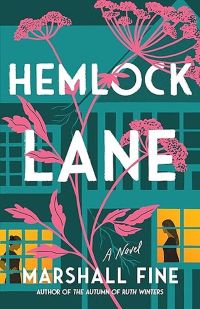
A Novel
In this riveting story of family bonds and buried truths, a young woman’s homecoming becomes a reckoning as four days together threaten to shatter the comfortable lies that have held her family together.
In the summer of 1967, the Levitsky family convenes for a long weekend at their home in the suburbs—an idyllic holiday for the perfect family.
But Nora has always known better.
Growing up, she learned to tiptoe around her mother Lillian’s explosive temper. Her father did the same. Nora’s sole confidante was their housekeeper, Clara, and their bond has only strengthened through the years. In fact, it’s all that’s keeping Nora together for her homecoming. But under that lifetime of pressure, the facade is beginning to splinter.
Over the next four days, everyone’s secrets are at risk. None more so than what Nora really wants for her life, how Clara has helped her get it…and how they’ve orchestrated it all behind Lillian’s back.
As the family grapples with the complex ties that bind them, Nora discovers that facing the truth—however painful—might be the key to finally breaking free. This weekend, Nora’s bravest act may be in knowing which bonds to cherish and which ones need to be gently set aside, making room for a future of her own choosing.
Coming of Age | Women’s Fiction Family Life [ Lake Union Publishing, On Sale: November 25, 2025, Hardcover / e-Book, ISBN: 9781662530487 / eISBN: 9781662530494 ]
Buy HEMLOCK LANE: Amazon.com | Kindle | BN.com | Apple Books | Kobo | Google Play | Books-A-Million | Indie BookShops | Ripped Bodice | Audible | Walmart.com | Amazon CA | Amazon UK | Amazon DE | Amazon FR
About Marshall Fine

Marshall Fine is an author, journalist, critic, historian, and filmmaker. His first novel, The Autumn of Ruth Winters, will be published by Lake Union Press in November 2024. His second novel, Clara’s Girl, was recently purchased by Lake Union Press. Fine is the author of three biographies: Bloody Sam: The Life and Films of Sam Peckinpah (1991); Harvey Keitel: The Art of Darkness (1998); and Accidental Genius: How John Cassavetes Invented the American Independent Film (2006). Fine started writing rock criticism for the Minneapolis Star at the age of 18, beginning a journalism career that covered a half-century. He spent 25 years as film critic and entertainment writer for Gannett Newspapers and another 10 as film/TV critic for Star magazine. He wrote the website Hollywood & Fine.com from 2008-16. His writing has appeared in the Los Angeles Times, New York Daily News, USA Today, New York Observer, Variety, Premiere, Cosmopolitan, Sports Illustrated, Penthouse, Indiewire.com and Entertainment Weekly. He conducted the Playboy Interview with both Howard Stern and Tim Robbins, and wrote more than two dozen cover stories for Cigar Aficionado as contributing editor. Fine is a four-time former chairman (1992, 2002, 2006, 2015) and member emeritus of the New York Film Critics Circle. He was named general manager of the NYFCC in 2016 and retired from the position in 2021. He received a special award from the group in 2022 for “service to the group and his many decades on the New York film scene.” After 20 years of programming and hosting subscription film clubs at four different venues in the New York area, he retired in May 2021 as critic-in-residence at The Picture House in Pelham, NY, where he created its sold-out film club. He received the Harold Lloyd Lifetime Achievement Award from The Picture House in 2021. Fine spent the 2020-21 academic year as an adjunct journalism professor at Purchase College-SUNY. He directed and produced the documentary features Robert Klein Still Can’t Stop His Leg and Do You Sleep in the Nude?, and the short documentary, Flo Fox’s Dicthology. His photography show, “Natural & Unnatural,” was exhibited in the Ossining Public Library Gallery in January 2023.
WEBSITE |
.
No Comments
Comments are closed.