

Excerpt from NO MAN’S LAND by Simon Tolkien:
The company left at midnight. Tallow-faced, unshaven, and exhausted, the soldiers marched with stony, expressionless faces along the moonlit road and then fell into single file when they reached the communication trench, picking their way slowly through the mud. Their uniforms were still wet and they shivered, grimacing with pain as the blisters on their swollen feet rubbed against the inside of their hard hobnailed boots.
Frequently they had to stop, flattening themselves against the crumbling walls of the trench as stretcher-bearers came stumbling past with their burdens hidden under dirty blankets. And sometimes they fell, slipping on the unstable duckboards, but they didn’t have the energy now for more than a few muttered oaths as they picked themselves up and went on.
The guns had been largely quiet as they passed, but a stray shell hit a dump of Very lights and set off a mad firework display that illuminated their surroundings in a blaze of fantastic colours just as they came to a break in the communication trench where it crossed a cart track used by supply vehicles.
They could see that they were standing at the entrance to a wood—or rather the remains of a wood. It had undergone such terrible destruction that there was no way for Adam to know whether it was the same wood where he had lain trapped beneath the huge tree trunk three weeks earlier. All the oaks and birches had been either uprooted or blasted down into jagged leafless stumps, allowing the soldiers to see past them into the interior. There were dead men out there: From where he was standing, Adam could make out fragments of ragged uniform and rifles and distended limbs sticking up above the tangled undergrowth and broken timber. Perhaps it was a trick of the lights, but Adam fancied he could see dead hands waving gently in the breeze.
Here and there the impact of larger shells had created sizeable craters that were now filled to overflowing with rusty water that was the colour of dried blood, and above one of these ponds Adam could see the bald head of a soldier staring back at him out of empty eye sockets, wreathed in a lurid green haze that Adam recognized as gas.
This was more wasteland than wood. Ghastly and ghostly in equal measure, it appeared to Adam like an angry storm-tossed sea frozen at the height of its turmoil.
The lights fizzled out and a spectral moonlit calm returned to the wood as Adam’s company made their way up to the new front line through recently captured German trenches. In the aftermath of the attack the British had been too preoccupied with dealing with their own casualties to find time to remove the bodies of the dead German defenders, and in some places there was no choice but to walk on them. Holding their noses against the sweet stench of putrefaction, the soldiers felt they were balancing on top of a series of air cushions with the soft bodies wobbling and yielding under their feet.
Luke made the mistake of looking down and started to shake. The rain had hastened the process of decomposition, and some of the Germans’ faces were turning inky black around the white teeth which they had exposed in the agony of their deaths. It was too much. “I can’t,” he moaned, coming to a halt. “I can’t do this.”
“Can’t what?” demanded the company sergeant major, who had been two men back from Luke in the line and had now pushed his way forward past Adam to find out what was causing the delay.
“I can’t walk on ’em. Not on their faces,” said Luke with tears in his eyes.
“Well, then fucking jump,” said the sergeant major brutally, and he pushed Luke hard in the back so that he almost fell. “We ain’t got no time to dawdle, Mason, you hear me? We have to go before dawn or the Jerries’ll see us coming. I’m going to be right behind you from now on, and if you stop again I’ll put a bullet in your head. I swear to Jesus I will.”
Luke kept going after that. But it was still dark when they got to the front-line trench and they had to wait twenty minutes before the hurricane bombardment began. And then it was all just as it had been before: bullets flying in the smoke and the exploding barrage up ahead and the troops creeping along behind it or at least those that were able to stay upright as they tried to pick their way through the treacherous undergrowth.
There was one change: Adam saw the colonel over to his right and wondered what the hell he was doing. It was against orders for field commanders to join in the attacks. Perhaps he’d had enough, Adam thought. Perhaps he couldn’t stand to take another roll call of the dead and wanted to share their fate instead. If so, he soon got his wish, blown to pieces by a high-explosive shell almost as soon as they had gone over the top.
Adam kept close to Luke just as he’d promised Rawdon he would. They followed the barrage through the trees and came out into a ride across from the German trenches, and that was where their luck ran out.
Shells were falling everywhere. Adam thought they had to be British; there was no way the Germans would shell so close to their own trench line. And, just as on the first of July, Adam could see the German defenders firing from the top of their trenches. In the predawn light he could make out their faces, some with glasses, some with moustaches, and each and every one of them taut with a fear and agitation that mirrored his own. Until suddenly they were gone, and he was flying up into the air, and everything was blue and then black by the time he fell back to the ground.
He came to in the sunlight. He was lying on his back, and he knew he was wounded because it hurt terribly when he tried to move. Pushing himself up with his arms, he could see a mess of blood on both his legs. He was weak, terribly weak, and it took all the strength he had left to reach round and get his water bottle. He drank deeply: He sensed he was going to die, so there was no point in stinting himself.
And then he lay back exhausted on his left side: For some reason he felt more comfortable in that position, and as long as he stayed still he felt no pain. After a few moments he opened his eyes and saw Luke, lying on his side, too, facing him. It was as though they were engaged in some secret conversation except that Luke was dead. Adam knew that straightaway. His green eyes were glazed over and opaque, and Adam felt a vast sadness engulf him. He remembered oh so much, a flash of visions tumbling through his mind: Luke flying down the hill on his bicycle; Luke dripping and laughing as he waded out of the hidden lake laden with the silver fish for their picnic; Luke grinning sheepishly for the camera with the ill-fitting Pickelhaube helmet perched ridiculously on top of his head; Luke so alive and yet now so dead! How was it possible? How could something as miraculously multifarious as a human personality end in a moment, snuffed out by an explosion and a shard or two of scrap-iron shrapnel?
The bitter grief exhausted Adam. He didn’t have the energy to think any more; he was just seeing. Images passed across his eyes: the blasted, splintered trees; the azure blue of the sky; the emerald wings of a green hairstreak butterfly fluttering above the arid broken ground a yard or two away. It settled on the lapel of Luke’s jacket, half camouflaged by the khaki. Perhaps it knew that he was dead. And Adam watched as its wings quivered in the sunlight. Dull brown and nondescript when open but iridescent green when closed. So delicate, so beautiful, so unexpected: The green matched the colour of Luke’s eyes. Life and death side by side: the wonder of it; the inexplicable wonder!
He could hear shots: revolver shots. And voices: German voices. They were coming closer. And there was nowhere to hide; no body to lie beneath. Not this time. Adam reached out and took hold of Luke’s hand, and then he sighed and closed his eyes. He didn’t want to see his own death.
Excerpt from NO MAN’S LAND by Simon Tolkien, Text copyright © 2025 by Simon Tolkien, Published by Lake Union Publishing
NO MAN’S LAND by Simon Tolkien
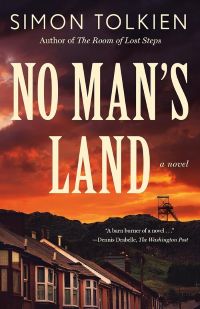
A Novel
Through divergent experiences of working-class poverty, country house privilege, and the trenches of WWI, a boy comes of age in a rapidly changing world in an epic novel by the author of The Palace at the End of the Sea and The Room of Lost Steps.
London 1910. Adam Raine is a boy cursed by misfortune. Following his mother’s tragic death, he moves north to Scarsdale, a hard-living coal-mining town, where his father finds work as a union organizer. But soon escalating tensions between the miners and their employer, Sir John Scarsdale, explode with terrible consequences. In the aftermath, Adam is taken into the Scarsdale family home, where Sir John’s son Brice is his rival for the love of the parson’s beautiful daughter. As Brice plots Adam’s downfall, the country teeters on the edge of a war that will change everyone’s lives forever.
From the gruelling workhouses of London to the suffocating Yorkshire mines, from the privilege and repression of an Edwardian country estate to the explosive trenches on the Western Front, Adam’s journey from boy to man unfolds against the backdrop of a society violently entering the modern world.
No Man’s Land is an epic coming-of-age novel about overcoming adversity through the power of love, hope, friendship, and an unyielding refusal to surrender.
Revised edition: This edition of No Man’s Land includes editorial revisions.
Historical | Military | Coming of Age [ Lake Union Publishing, On Sale: November 11, 2025, Paperback / e-Book, ISBN: 9781662532733 / eISBN: 9781662532740 ]
Buy NO MAN’S LAND: Amazon.com | Kindle | BN.com | Apple Books | Kobo | Google Play | Books-A-Million | Indie BookShops | Ripped Bodice | Walmart.com | Amazon CA | Amazon UK | Amazon DE | Amazon FR
About Simon Tolkien

I live in Santa Barbara, California where the sky really is as blue as the deep blue sea most days, and I love the roar of the ocean, the majestic mountains, the white Spanish adobe architecture, and the twisting oaks and carpets of flowers in my yard where I walk with my beloved pug, Sadie, twice a day. It’s a long way from the sleepy Oxfordshire village where I grew up and the Catholic boarding school where I spent my teenage years.
I studied modern history at Trinity College, Oxford and then reluctantly went to law school. I thought that I was putting my life in a straitjacket, but criminal law was a revelation. In the London prisons and police stations I met people from every walk of life, and I became a barrister because I wanted to represent them in court, rather than just prepare their cases for trial. I loved the drama and responsibility of the work, but then at the age of forty-one, I decided to reinvent myself as a novelist, even though I had never written a word of fiction before! I am the grandson of J.R.R. Tolkien and I think that his immense literary achievements had inhibited me up to then. I started with what I knew and wrote courtroom dramas, and then this developed into crime thrillers with historical settings, and finally character-driven historical fiction. I loved history as a child and my novels have enabled me to recapture the sense of wonder I felt about the past as being another country just as real as our own. My focus has been on the turbulent first fifty years of the 20th century and my settings have included the London Blitz, the Battle of the Somme, and now, in my forthcoming duology, New York in the Great Depression and the Spanish Civil War.
I have been so lucky to have been married for forty years to my wife, Tracy who has encouraged me in all my creative endeavors. She is a writer herself and an expert on vintage fashion and jewelry, and we have two wonderful children, Nicholas and Anna.
No Comments
Comments are closed.