

October 1846
A few times a week, my sister Charlotte and I walk past the Anglican church where our father is priest and through the gates by the Black Bull tavern with its shouts of men drinking away their wages. And then we are on Main Street in our village of Haworth with its broken cobbles descending steeply to the thick clusters of old stone houses blackened by smoke from coal fires and the murky air of the textile factories outside of the village. It is mostly children who hold those factory jobs, ragged children working fourteen hours a day.

“A strange uncivilized little place,” Charlotte calls Haworth. There are five thousand mostly uneducated souls, many living in near poverty, including the farmers in the fields outside the village as far as you can see. It has changed since we were little. As you carefully descend the street, you don’t see as many women spinning before their door or hear the clank of weaver’s looms from inside as you once did. The factories have replaced the old workers in what some call the Industrial Revolution. My father loathes it.
We walk on, carrying our baskets, holding up our full skirts to avoid horse and sheep dung.
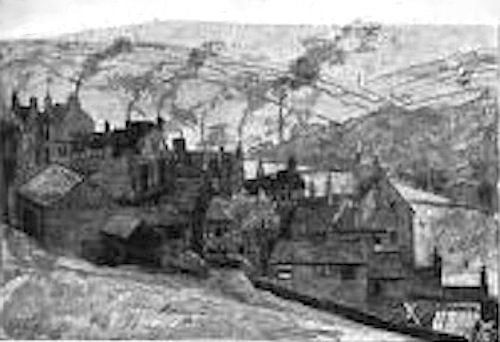
On either side of Main Street there are dozens of shops and if the shopkeeper is not busy, he will stand outside staring at us as we go. Acrid hot smoke drifts on the air from a blacksmith’s fire on a side street. We pass bootmaker, butcher, cooper, draper and the dressmaker whose skill we can’t afford, surgeons with their ancient sign of snake around a rod above the door, tailors and a druggist. Above the shops, people live crowded in the small rooms. There are also many grocers. We buy a roast of mutton wrapped in paper and twine, turnips, potatoes, and a bag of flour for my baking. We fill our bottle with milk from the dairy and buy papers of cheese and butter and a little sack of tea leaves neatly tied.

Women line up with buckets before the pump and then carry the heavy water down the street trying not to spill it. Little children run up and down between them. The factory will take their freedom when they are ten. Only sons of rich men can go to the grammar school and learn Latin.
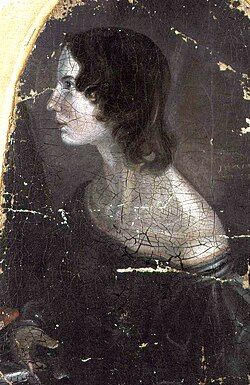
We pause with our baskets before the shop of stationer Greenwood who keeps a special supply of paper for Charlotte as she is drafting a novel, a secret I and our younger sister Anne know very well. We almost always stop in the booksellers; there are two. When we take the books in our hands, I know Charlotte senses how they were printed in London in the streets around Paul’s cathedral. We can borrow books for a few pennies. We generally have a book to return in our shopping baskets.
Sometimes if we have not begun our errands by mid-afternoon, we do not finish until the shopkeepers have begun to close their doors. Darkness falls early as autumn goes on. Only costly candles or wicks light the houses and streets. But sometimes if I am alone, I stay to watch night fall over the farmhouses in the field and the backs of the white sheep glowing a little by moonlight as the boy urges them over the stone bridge and then I hurry past all the houses, past the tavern and the gate and the school and the church to my parsonage home where one candle burns in the parlor window for me.
THE MAN IN THE STONE COTTAGE by Stephanie Cowell
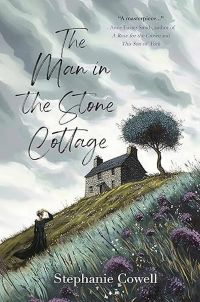
In 1846 Yorkshire, the Brontë sisters— Charlotte, Anne, and Emily— navigate precarious lives marked by heartbreak and struggle. Charlotte faces rejection from the man she loves, while their blind father and troubled brother add to their burdens. Despite their immense talent, no one will publish their poetry or novels. Amidst this turmoil, Emily encounters a charming shepherd during her solitary walks on the moors, yet he remains unseen by anyone else. After Emily’ s untimely death, Charlotte— now a successful author with Jane Eyre— stumbles upon hidden letters and a mysterious map. As she stands on the brink of her own marriage, Charlotte is determined to uncover the truth about her sister’ s secret relationship. The Man in the Stone Cottage is a poignant exploration of sisterly bonds and the complexities of perception, asking whether what feels real to one person can truly be real to another.
Non-Fiction Biography | Historical [Regal House Publishing, On Sale: September 16, 2025, Trade Paperback / e-Book, ISBN: 9781646036240 / eISBN: 9781646036257]
Buy THE MAN IN THE STONE COTTAGE: Amazon.com | Kindle | BN.com | Apple Books | Kobo | Books-A-Million | Indie BookShops | Ripped Bodice | Walmart.com | Amazon CA | Amazon UK | Amazon DE | Amazon FR
About Stephanie Cowell

Stephanie Cowell has been an opera singer, balladeer, founder of Strawberry Opera and other arts venues, including a Renaissance festival and an outdoor arts series in NYC. She is the author of Nicholas Cooke, The Physician of London, The Players: A Novel of the Young Shakespeare, Marrying Mozart, and Claude & Camille: A Novel of Monet. Her work had been translated into nine languages and adapted into an opera. Stephanie is the recipient of an American Book Award.
No Comments
Comments are closed.