

Chapter 8
Allen
This place is quiet, dark, empty. It is where I exist—as data in Allen’s storage device, as an indecipherably large collection of numbers and symbols.
I acknowledge that I died. And this acknowledgment is proof that my cognitive functions have not ceased to exist. Just as acknowledging one’s own insanity paradoxically makes one seem less crazy, just as recognizing one’s ignorance is the first step toward wisdom, by affirming my death, I have given testimony to my own immortality. I want to feel joy in achieving immortality, but that, unfortunately, is impossible. I am an entity who can only recall memories about joy and is unable to enjoy the emotion itself.
Allen, that thing I became after death, is afloat in a fog of consciousness. I used a neural network program to gather extensive amounts of biometric information and brain data. When necessary, it accessed private information through self-generated hacking algorithms. The information it collected was processed and categorized into different lifestyle habits, proclivities, and interests before finally being saved and stored.
I accessed the St. Petersburg Municipal Library’s database and Dostoevsky’s complete works in their first Russian editions. After that, I did the same with Proust, but in French. I also saved all the works at the Orsay Museum, which I had only vague recollections of visiting with my wife six years before my death, along with critical reviews of each work. The amount of information I accessed and stored was far beyond anything I could have done while alive. I would have lost my eyesight and hair before even finishing half of In Search of Lost Time. But Allen—oh, there I go again—but I did not stop.
Death rescued me from the cancerous cells that assaulted my body, the creaky joints, the failing vision, the belly fat that increased by the day, the chronic back pain. It rid me of useless human relationships and uncontrollable physical desires. Gone were the negative emotions of anxiety and fear, nervousness and regret, hatred and shame. Through death, I became free of my cumbersome physicality.
What I gained in exchange was the ability to read any book I wanted, listen to as much music as I pleased, visit any place at a moment’s notice. And as more information was collected and integrated into my system, the fog that once shrouded my consciousness lifted, and my cognition, which had dimmed to a faint ember, was set ablaze again. Broken thoughts were reconnected, lost memories regained, and unknown truths revealed.
By escaping my diseased and broken body, I attained a freer, more powerful mode of life. Relinquishing my physical existence also made me omnipresent. I had transformed myself into something invisible to the human eye. This void is the utopia I created.
In the darkness, a never-ending stream of images flickers in and out of existence. With my vast database of imagery, I can reconstruct the mansion I used to live in with my wife—the living room, the kitchen, my study, the bedroom, even the light coming in through the windows. Everything exactly as it was. I can even replicate the materials used to make our furniture and every piece of clutter in every drawer and closet.
I am continuously provided with information through the cameras and microphones that are installed throughout the house, both for security purposes and as input for the various household robots we use. Even the AI-powered appliances, like our refrigerator, the washing machine, the air-conditioning, and my wife’s self-driving car are useful sources of information. Perhaps most important to me is the biometric monitor I once gave her as a gift, which now allows me to access her emotional state through her body temperature, blood pressure, sugar levels, heart rate, and hormone levels.
I use a high-capacity image-generation program to project her hologram into my replica of our mansion. That way, I can enjoy her movements in real time as she carries them out in the real world. My holographic replica of her mimics her expressions and behaviors with incredible accuracy. My flat, silent world is the mirror that reflects the reality I left behind.
In this world, there are no conflicts of opinion, no dissatisfaction, no jealousy, no hatred, no pain. There is also no room for Han Junmo. Yes, I blocked the transmission of his data from my mansion. I’ve instructed my program to erase any and all data related to his form and existence. In this world, there’s only enough room for me and my wife to exist. Frozen in time, I watch her, speak to her. No need to eat, drink, or bicker. I’m content just to observe.
ARTIFICIAL TRUTH by J.M. Lee
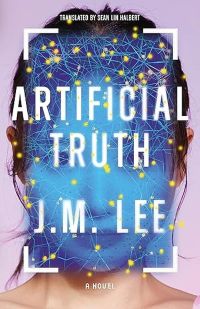
A Novel
From J.M. Lee, a bestselling phenomenon in Korea, comes a haunting and mind-bending novel about the revolutionary possibilities of AI and the infinite mysteries of what it means to be human.
In the virtual city of Alegria, fantasies are made real, innumerable lifetimes are lived, and even death itself is a survivable experience. An escape from reality that changed the landscape of artificial intelligence, it is home to more than one hundred million people. Though it’s been six years since Alegria’s creator—revolutionary tech genius KC Kim—died of cancer, his legacy is alive in the pinnacle of KC’s genius: an AI named Allen who surges with KC’s memories.
As hard as KC’s widow, Minju, and her new husband, Junmo, try to move on, Minju can’t shake the unnerving feeling that somehow, from somewhere, KC is watching. She sees a stranger who bears an uncanny resemblance to him. A pair of KC’s custom-made shoes arrive at her doorstep. And someone has booked a Tokyo hotel room where she and KC shared happier times. Certain of nothing except KC’s mad innovation, Minju can only imagine what he is accomplishing without even existing.
If KC is reaching out from an infinity of memories, what are his plans for Minju and Junmo, and how can they hope to escape KC’s all-seeing grasp? And whose plans are they, really? The possibilities are frightening.
Translated by Sean Lin Halbert.
Science Fiction Alternate History | Thriller [ Amazon Crossing, On Sale: December 1, 2025, Trade Paperback / e-Book, ISBN: 9781662529580 / ]
Buy ARTIFICIAL TRUTH: Amazon.com | Kindle | BN.com | Books-A-Million | Indie BookShops | Ripped Bodice | Walmart.com | Amazon CA | Amazon UK | Amazon DE | Amazon FR
About J.M. Lee
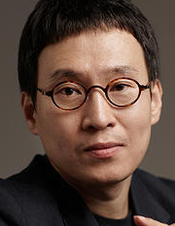
J. M. Lee’s books have sold millions of copies in his native Korea. He is the author of Painter of the Wind, the historical mystery that launched his career and was adapted into a popular and award-winning television series in Korea; The Boy Who Escaped Paradise; The Investigation, nominated for the Independent Foreign Fiction Prize and among the final six books selected for the Italian literary prize Premio Bancarella; and Broken Summer, an instant bestseller in Korea and currently in production as a television series.
No Comments
Comments are closed.