

This month’s selection of stories features protagonists who pioneer in professions or places they are not supposed to be. From the ground of ancient Egypt to the racetrack to the sky, the heroines (and heroes) of these stories will take you on the wild rides of those who don’t settle for safe, familiar, expected roles.

We begin with DAUGHTER OF EGYPT by Marie Benedict. Many know that one of the lords of Highclere Castle of “Downton Abby” fame was the Egyptologist and explorer who funded archeologist Howard Carter and assisted in the discovery of the tomb of the boy Pharaoh Tutankhamun. Less-well-known is that Lord Carnevon’s daughter, Lady Evelyn Herbert, preferred the dusty fields of Egypt to the ballrooms of London and was an integral part of the expedition. A self-trained amateur archeologist, Evelyn accompanied her father and Carter on their yearly digs. Though she was first to see the boy-Pharaoh’s tomb, what she really wanted to discover was the tomb of the female pharaoh Hatshepsut. The novel alternates Eve’s drive to find Hatshepsut’s tomb and the history of the pharaoh herself, a forward-thinking modernist who brought Egypt to new prosperity. Like her Egyptian predecessor, Eve defies the rules imposed by a male-dominated society, driven to discover more about the ancient woman who fascinates her and willing to risk the social and political consequences of advocating for Egyptian artifacts to remain in Egypt.
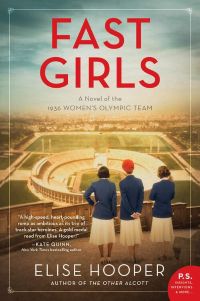
We leave the soil of Egypt for the Olympic track in FAST GIRLS by Elise Hooper. After winning a gold medal at the first-ever Olympic track and field event for women in 1928, Betty Robinson overcomes injuries suffered in an airplane crash, determined to work her way back to once again become a member of the U.S. women’s team. Making the team is the dream of two other very different women: Louise Stokes, who sees becoming an Olympian as a way to overcome the limitations placed on a black woman, and Helen Stephens, an awkward, gawky girl who has never fit in but whose racing speed may help her escape poverty on a Missouri farm. As the world edges closer to war, the three women battle racism, dismissive attitudes toward female athletes and society’s expectations of a woman’s proper role to earn their place at Hitler’s glittering showcase 1936 Olympics in Berlin. Based on the lives of the actual Olympic competitors, Hooper’s novel shows us the drive, talent and courage it took for these pioneers to open the world of competitive athletics to women.
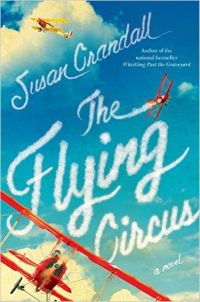
We go from girls with wings on their feet to real wings in THE FLYING CIRCUS by Susan Crandall. A girl on a motorbike who challenges a former World War I pilot to a race her in his biplane, the contest observed by a quiet boy on the ground, is the beginning of an unusual threesome that will bring barnstorming entertainment to the 1920’s Midwest. All are escaping something–Henry Schuler, an 18-year-old mechanic fleeing persecution for his German heritage and a potential murder charge; Cora Rose Haviland, escaping her mother’s plan to recoup the lost family fortune by having her marry wealth, and Gil Gichrist, using alcohol and daring flying maneuvers to block out traumatic war memories. With Cora riding ahead on her motorbike to drum up patrons, Henry to keep the plane and bike running, Gil to fly the biplane and Cora to entice paying spectators with her ever-more-dangerous wing-walking stunts, the trio tours the Midwest, sometimes in company with other barnstormers, sometimes alone. Crandell’s story gives us an intimate picture of the early years of flight and America of the 1920’s through the eyes of these three extraordinary individuals.
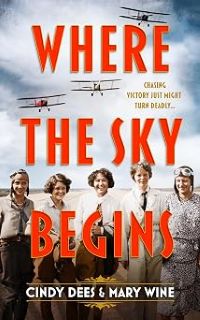
We finish with an historical account of a real race with real female pilots in WHERE THE SKY BEGINS by Cindy Dees and Mary Wine. The National Women’s Air Derby of 1929 was the first event to showcase women aviators. When Hollywood tries to take it over using movie starlets as “pilots” with mechanics to do the real flying, Florence “Pancho” Barnes recruits the best female aviators of the age, among them Amelia Earhart, Louise Thaden and Mavel Corsson, to join her and ensure the flight from San Bernadino to Cleveland is a race with actual female pilots. But some don’t want women to succeed as aviators; sabotage attempts to try to intimidate the women into quitting the race merely make them more determined, bonding them to watch each other’s backs and make it to the finish line. Against a rich background of 30’s America’s speakeasies, courtroom showdowns and publicity battles, we follow this group of intrepid aviators who wouldn’t be grounded, despite emergency landings, marginal flying conditions and the dangers of their always-fragile aircraft. A peon to the pioneering female aviators who refused to be confined to a woman’s traditional societal role.
Most of us lack the vision or the desire to be true pioneers, willing to risk danger and fight against prejudice and society’s expectations to forge ahead in a new field. But most of us also are fascinated by the stories of those who do possess that passion and drive, like the protagonists of this month’s stories. Grab a seat and come along on the journey!
About Julia Justiss

Real, intense, passionate historical romance
Award-winning romance author Julia Justiss, who has written more than thirty historical novels and novellas set in the English Regency and the American West, just completed her first contemporary series set in the fictional Hill Country town of Whiskey River, Texas.
A voracious reader who began jotting down plot ideas for Nancy Drew novels in her third grade spiral, Julia has published poetry and worked as a business journalist.
She and her husband live in East Texas, where she continues to craft the stories she loves. Check her website for details about her books, chat with her on social media, and follow her on Bookbub and Amazon to receive notices about her latest releases.
No Comments
Comments are closed.