

What is the title of your latest release?
SING DOWN THE MOON
What’s the “elevator pitch” for your new book?
Sixteen-year-old Leontyne Skye is bound by blood and legacy to Damascus, an ancient fig tree that grows on the Georgia island of Good Hope, a tree that feeds the dead and devours the living. As her mother disintegrates before her very eyes Leontyne must confront a birthright that will take everything from her as it has her mother – teeth, hair, and bone. Leontyne has already lost parts of herself – a hand, and her memory, in a happening two years prior known as Tribulation Day. When a mysterious stranger arrives on Good Hope, Leontyne’s memories slowly resurface, and with those memories, the discovery of a chilling truth. Rejecting her legacy will shatter the fragile balance between the living and the dead, forcing Leontyne to choose: save the island and those she loves, or save herself.
How did you decide where your book was going to take place?
I believe that I will always write stories about the American South, so from the get-go, placing it in the region was a given. Setting it on a remote Georgia coastal barrier island gave the place a sense of isolation, and within this isolation, the perfect sandbox to cultivate the longing of other places that lives withing young Leontyne. Place fuels her motivation. It serves as an obstacle. It is a main character.
Would you hang out with your heroine in real life?
Absolutely. We are kindred spirits, Leontyne and me. I think I already do hang out with her in a way. She lives within me. Always will. In the way that all my characters do.
What are three words that describe your hero?
Haunted. Defiant. Tender.
What’s something you learned while writing this book?
I learned that I’m more tethered to the idea of inheritance than I realized – not just what we receive, but what we’re expected to carry without ever agreeing to it. Writing Leontyne forced me to look closely at the things we endure out of love and loyalty, and how often survival asks us to give up pieces of ourselves.
I also learned that I’m drawn to quiet strength. I didn’t set out to write a heroine who was loud or heroic in a traditional sense, but Leontyne taught me how powerful restraint can be – how courage often looks like staying when leaving would be easier. Sitting with her grief and her defiance showed me that I trust discomfort as part of the creative process, that I’m willing to let a story unsettle me if it means telling the truth.
Do you edit as you draft or wait until you are totally done?
I edit as I draft. I know all the advice says not to – that you should just get the words down and fix it later – but I’ve never been wired that way. I can’t move forward unless I feel there’s some real quality on the page, something solid enough to stand on. If a paragraph feels false or lazy, it slows me down more than stopping to fix it ever could.
Part of that is probably perfectionism, and part of it is trust. I have people reading my work as I go, and I want to give them something that’s thoughtful and intentional, not just scaffolding. Editing while drafting helps me stay connected to the voice and the emotional truth of the story. It keeps me honest.
What’s your favorite foodie indulgence?
Chicken and dumplings.
Describe your writing space/office!
My writing desk is, in a way, the center of my world. It’s classic Southern in feel – dark wood, a little worn in the right places – but with touches that are entirely my own, a little eclectic, a little unexpected. I have a mix of modern and classical art around me, pieces that keep me thinking, pieces that make the room hum with possibility.
Candles are always burning when I write. I can’t work in clutter. Everything has its place, because disorder seeps into the mind, and I need clarity as much as inspiration.
I can sit there for hours and feel like I’m somewhere outside time, and yet entirely at home. The desk isn’t just where I write – it’s where I meet the characters, where I listen, and where I let the story speak.
Who is an author you admire?
I am fortunate to know many gifted authors. Therefore, it is a dangerous endeavor to list a person I know well, while ignoring all the others. So, I would have to say, Karen Russell, author of Swamplandia. I hope to meet her one day. If you know her, please tell her to give me a call.
Is there a book that changed your life?
Yes – OTHER VOICES, OTHER ROOMS by Truman Capote absolutely changed my life.
I read it at a time when I was trying to understand what it meant to belong to a place and yet feel haunted by it. Capote showed me that the South could be written as something lush and eerie and psychologically charged, not just nostalgic or polite. The atmosphere in that novel – the way the landscape feels alive, watching, almost complicit – gave me permission to lean into strangeness and beauty at the same time.
What struck me most was how intimate and fearless the book is. Capote didn’t flinch from vulnerability or from otherness. He let longing, isolation, and desire sit right there on the page, unprotected. That taught me that a novel doesn’t have to explain itself or apologize – it just has to tell the truth in its own language.
OTHER VOICES, OTHER ROOMS helped me understand that voice matters as much as plot, and that place can function like a character, one that shapes and distorts everyone who moves through it. That lesson has stayed with me in everything I’ve written since.
Tell us about when you got “the call.” (when you found out your book was going to be published). Or, for indie authors, when you decided to self-publish.
I remember that moment vividly – I got the email from Mercer University Press, and honestly, I had to read it twice to make sure I wasn’t imagining it. There was this rush of disbelief, and then pure joy. I felt every bit of the years of work, the revisions, the early morning and weekends – the doubts, all suddenly recognized.
I was overwhelmed with gratitude – not just to Mercer for believing in the story, but to everyone who had read my pages along the way, who encouraged me when I felt alone. It was like the book had grown beyond my writing desk, beyond my own hands, and was finally going to find its place in the world.
What’s your favorite genre to read?
As you might expect, Southern literary fiction. But my tastes are quite diverse. I read everything. Some things I won’t admit to.
What’s your favorite movie?
That is a hard question. I have many favorites. But I will settle on the film adaptation of Tennessee Williams’s play, Suddenly Last Summer, starring Elizabeth Taylor, Montgomery Clift, and Katharine Hepburn. I watched this film when I was a teenager, and it has stayed with me ever since.
What is your favorite season?
Winter. I love to dress in layers. I love fireplaces. I love to be home. I love to nest. I long for the magic of snow – a thing rare here in these parts.
How do you like to celebrate your birthday?
It almost always involves a Delmonico cut steak and baked potato. Cocktails on the sofa with my partner. And a really good movie.
What’s a recent tv show/movie/book/podcast you highly recommend?
The 2025 film, Sinners, a supernatural horror film directed by Ryan Coogler, putting lens to supernatural evils in 1932 Mississippi. I believe it has been nominated for an Academy Award.
What’s your favorite type of cuisine?
Southern. And all things fried. But I try to approach this vice with moderation.
What do you do when you have free time?
It seems I hardly ever have free time. But when I do – you can find me reading and watching films, cuddled on the sofa with my two dogs, Truman and Capote.
What can readers expect from you next?
I am working on a piece of Southern Gothic fiction told from the perspective of a thirteen-year-old boy named John Mark Alderbranch. This will be the first time I have written from the male point of view. The book will be told in three acts, and I have just completed a draft of the first.
SING DOWN THE MOON by Robert Gwaltney
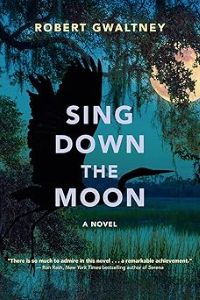
Sixteen-year-old Leontyne Skye yearns to escape Good Hope, the remote Georgia coastal barrier island where she resides. Leontyne’s heritage is bleak. Tasked with tending Damascus, an ancient fig tree beguiling haints across the river with its wind chime song, Leontyne’s mother, Eulalee, disintegrates into tufts of hair, teeth, and memory. This affliction befalls all Skye women, a fatal consequence of distilling Redemption, an addictive drug made from the figs of Damascus imbued with the essence of haints. Leontyne also tumbles apart, her memories and hand lost in a life-altering accident suffered two years back during an event known as Tribulation Day. Through unreliable recollections of her trusted friends the Longwood twins, Leontyne stitches a dubious understanding of who she was before she fell “the long-long ways.” In the aftermath of Eulalee’s death, Leontyne is pressured by the Longwoods to render Redemption, continuing the legacy upon which Good Hope depends.
Literature and Fiction [ Mercer University Press, On Sale: March 3, 2026, e-Book, / ]
Buy SING DOWN THE MOON: Kindle | Amazon CA | Amazon UK | Amazon DE | Amazon FR
About Robert Gwaltney
Robert Gwaltney is the author of Sing Down the Moon (Mercer University Press, 2026) and The Cicada Tree (Moonshine Cove Publishing, 2022), works of Southern literary fiction that explore inheritance, identity, and the fragile boundary between the living and the dead. Rooted in the landscapes and histories of the American South, his writing blends the gothic tradition with elements of magical realism to illuminate the forces that shape who we become.
Raised in Cairo, Georgia, alongside three younger brothers in the rash-inducing subtropical heat of the region, Gwaltney is a lifelong resident of the South — a circumstance that has left an indelible mark on his voice as a writer. Sense of place remains central to his work, where memory, myth, and longing intertwine.
By day, he serves as Vice President of Easterseals North Georgia, championing early childhood literacy and strengthening families at critical stages of development. In all the hours between, he writes.
He lives in Atlanta, Georgia, with his partner.
No Comments
Comments are closed.